Road Rage's Hideout
MARRIED TO MY MASTER: A Bad Boy Hitman RomanceRoad Rage's Hideout is a remote house that serves as a gang base and a place of captivity, rather than a secure or orderly clubhouse. Its distance from other people makes help difficult to reach, while the same lack of organization that leaves captives vulnerable also creates openings for escape. The house's role changes from a hidden place observed from the roadside to the destination of a direct rescue, where Grizzly's priority is finding Ana.
Setting and Approach
The hideout stands far from ordinary settlement, reached by a dirt road that leaves a visitor traveling through an isolated stretch. Rodent brings a captive to a house away from what seems like most of civilization; the distance offers the gang seclusion, but leaves the captive uncertain how to get away without help. The setting is therefore not merely a backdrop. It determines the practical terms of captivity: the house is difficult to reach, and the surrounding remoteness makes escape feel uncertain.
Another approach to the property reveals details that complicate its concealment. A visitor follows the dirt road, stops the motorcycle before reaching the house, moves it off to the side, and continues on foot through a small wood at the edge of the property. From among the trees, the visitor watches the house. Its windows have no curtains, leaving the interior visible from outside. The location is secluded, but it is not fully screened from observation; its openness creates a vulnerability even before anyone enters.
The House and Its Use
The building is called a clubhouse by the people investigating it, but what they find inside does not resemble a functioning motorcycle-club headquarters. There are few, if any, motorcycles outside, and the gathering inside appears disorganized. The description emphasizes a group occupied with drug use rather than people acting like a disciplined organization. The contrast between the clubhouse label and the disorder within makes the house seem less like a stable institution's center than a makeshift base.
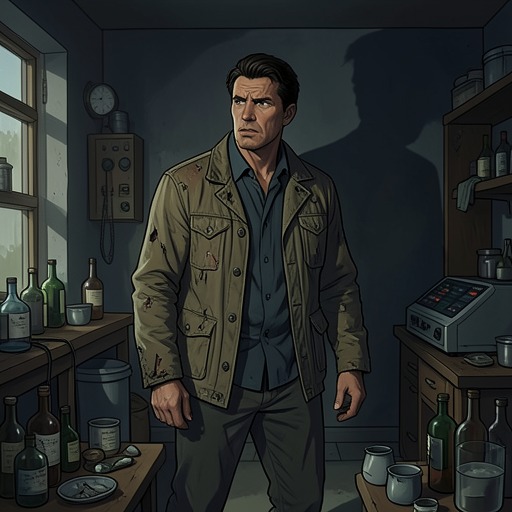
The central room has an old table surrounded by folding chairs. Drug-related materials and other supplies cover the tabletop, and several people sit around it. The arrangement suggests a shared gathering place, but not a formal meeting space: the table is crowded, the chairs are makeshift, and the people present are not shown conducting organized business. The room's visible disorder helps establish the character of the gang operating there without implying that its members lack the ability to detain or threaten someone.
Captivity and the Possibility of Escape
For Rodent's captive, the house's distance from other people is an immediate obstacle. The captive does not know what Rodent intends to do or how to escape alone. The hideout thus exerts its power less through described fortifications than through its isolation: there is no nearby community or obvious source of assistance, and the captive has to assess the surroundings while uncertain about what will happen next.
Yet the house is not made into an inescapable enclosure. During one escape, the captive gets through a window and runs toward the woods. The motorcycle has not been brought close to the house, an omission that leaves a possible means of escape beyond immediate reach; at the same time, the gang has not ensured that the captive has no way out. The route through the window and toward the trees turns the property's physical features into an opportunity. The same lack of organization that distinguishes the hideout from a conventional clubhouse has practical consequences for the people held there.
The Rescue and the House's Narrative Role
Later, Grizzly returns to the hideout with others, taking the fastest route there rather than trying to conceal their approach. A small group is gathered outside. They do not appear prepared or composed like a force going into battle; their behavior suggests impairment and disarray. The contrast between their presence at the entrance and the rescuers' purposeful arrival makes the house a threshold between confrontation and the urgent task inside.
Grizzly storms into the building with Ana as the priority. He finds her lying on the floor, seriously injured and bleeding. The discovery makes the hideout's earlier function as an isolated place of captivity newly consequential: the house is not only where the gang keeps people beyond easy reach, but also where the consequences of that violence become impossible to ignore. The account establishes the seriousness of Ana's condition at the moment she is found; it does not make the house itself a source of safety or resolution.
Significance
Road Rage's Hideout is defined by a tension between remoteness and exposure. Its out-of-the-way location helps the gang operate beyond ordinary scrutiny, yet its bare windows allow an observer to watch from the woods, and its physical layout permits escape through a window. Inside, the makeshift table and scattered drug-related materials contrast with the authority implied by the word clubhouse. The place appears disorderly, but its isolation still gives that disorder dangerous force for anyone held there.
The location also links separate stages of the conflict: surveillance from the roadside, confinement in the house, escape toward the woods, and the later effort to reach Ana. Its meaning shifts with those actions. At first it is a destination difficult to find; then it is a trap whose isolation constrains a captive; finally it is the site of a rescue attempt and a stark discovery. The house's importance comes not from elaborate construction or a formal role, but from how its distance, visibility, and disorder shape what the characters can do there.